






MENA crypto adoption drops in 2026 while Sub Saharan Africa grows
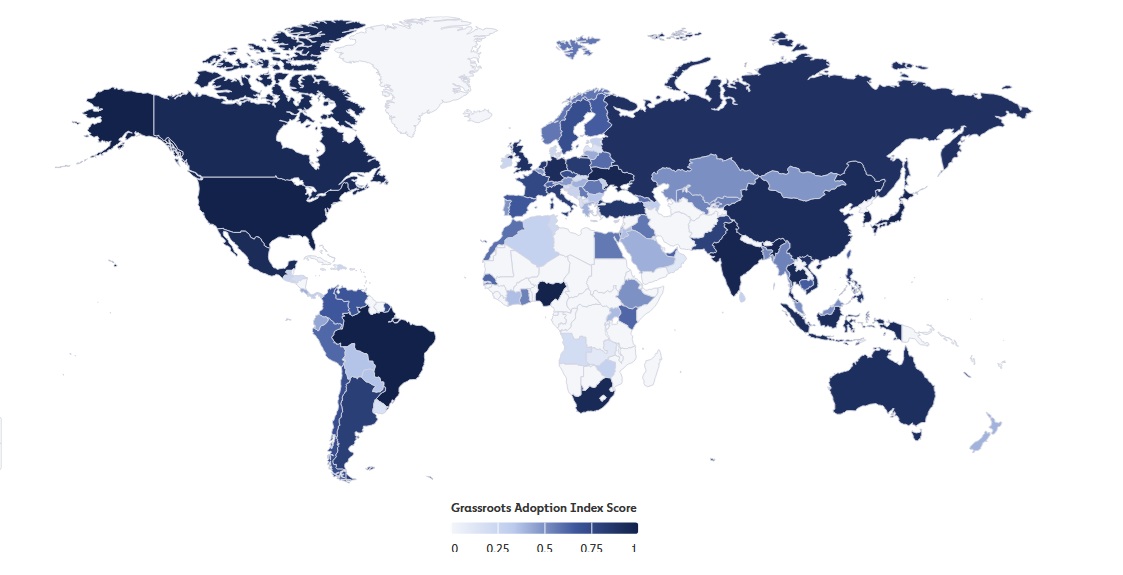
In a glimpse of the upcoming 2026 Global Crypto Adoption Index from Chainalysis, figures highlight a notable shift in the global cryptocurrency landscape, with the Middle East and North Africa (MENA) region losing ground in global adoption rankings even as peer-to-peer (P2P) crypto activity accelerates across the region. At the same time, Brazil has emerged as the world’s leading market for grassroots crypto adoption, surpassing the United States of America, while Türkiye remains the only MENA country in the global top 20.
According to Chainalysis, Brazil ranked first globally in the 2026 index, ahead of the United States, after demonstrating consistently strong performance across service flows, cross-border crypto transfers, on-chain balances, and domestic P2P activity. The company noted that Brazil’s crypto economy reached approximately $252.5 billion, making it the strongest overall grassroots adoption market despite not leading any single category. The United States fell to second place, reflecting a growing shift in adoption momentum toward emerging markets.
For MENA, the picture is less encouraging, with crypto adoption decreasing by 1.4 percent while Sub Saharan Africa grew by 13.4 percent. The 2026 global rankings include only Türkiye at number 20, making it the sole representative from the region among the world’s leading crypto adoption markets. No Gulf Cooperation Council (GCC) country appears in the global top 20 rankings this year, underscoring a decline in the region’s relative position compared with faster-growing markets in Latin America, Africa, and Asia.
The findings contrast with Chainalysis’ 2025 regional assessment, which portrayed MENA as a resilient crypto market led by Türkiye and the UAE. At the time, Chainalysis reported that Türkiye dominated regional cryptocurrency activity with nearly $200 billion in annual transaction volume, while the UAE ranked second with approximately $53 billion. However, the report also noted that MENA’s growth was already lagging behind other emerging regions, expanding at a slower pace than both Latin America and Asia-Pacific markets.
Stablecoins center of P2P rise in crypto usage
While overall adoption rankings suggest weaker momentum for MENA, one area continues to expand rapidly: peer-to-peer cryptocurrency usage. Chainalysis found that global domestic P2P crypto transfers surged by more than 300% year-over-year, rising from $56.8 billion to $228.7 billion. The share of P2P activity increased across all eight global regions, including MENA, driven largely by stablecoin usage rather than speculative trading.
The report indicates that stablecoins are increasingly being used for payments, remittances, savings preservation, and cross-border commerce. Chainalysis observed that cross-border stablecoin transfers grew 77.5% during the reporting period, rising from $124.2 billion to $220.3 billion. This trend is particularly relevant for MENA, where many users rely on digital assets to move money internationally, hedge against currency fluctuations, and access alternative financial infrastructure.
Another key takeaway is that the crypto economy proved remarkably resilient despite a severe market downturn. Although the total cryptocurrency market capitalization contracted by roughly 50%, global on-chain economic activity declined by only 1.6%, from $9.5 trillion to $9.4 trillion. Chainalysis attributes this resilience to the growing diversification of crypto use cases, particularly stablecoin payments and cross-border transfers, rather than pure investment speculation.
Compared with the 2025 adoption index, which highlighted strong positions for markets such as India and the United States and continued growth across several emerging economies, the 2026 report signals a changing balance of power. Latin America, led by Brazil, has become one of the strongest crypto adoption regions globally, while African markets such as Nigeria and South Africa have climbed on the back of strong peer-to-peer activity. Meanwhile, MENA’s presence in the global rankings has narrowed to Türkiye alone, suggesting that regional adoption growth is increasingly being outpaced by other emerging markets.
The data suggest that while MENA may be losing ground in overall adoption rankings, the region remains an important contributor to one of crypto’s fastest-growing segments: stablecoin-powered peer-to-peer transactions. As real-world payment and remittance use cases continue to expand, MENA’s future crypto growth may depend less on speculative trading volumes and more on its ability to capitalize on this growing digital payments infrastructure